
How much is a letter worth?
Why is the letter «Ж» worth 5 points while the letter «Й» is worth only 2? Who decided that? We found out, checked and recalculated.
The riddle
The price of a letter in games like Scrabble is not made up: the rarer a letter is, the more points it brings. The creator of Scrabble, Alfred Butts, counted letters by hand. In 1968 the magazine Nauka i Zhizn (Science and Life) printed a similar table for the Russian language.
How the table works
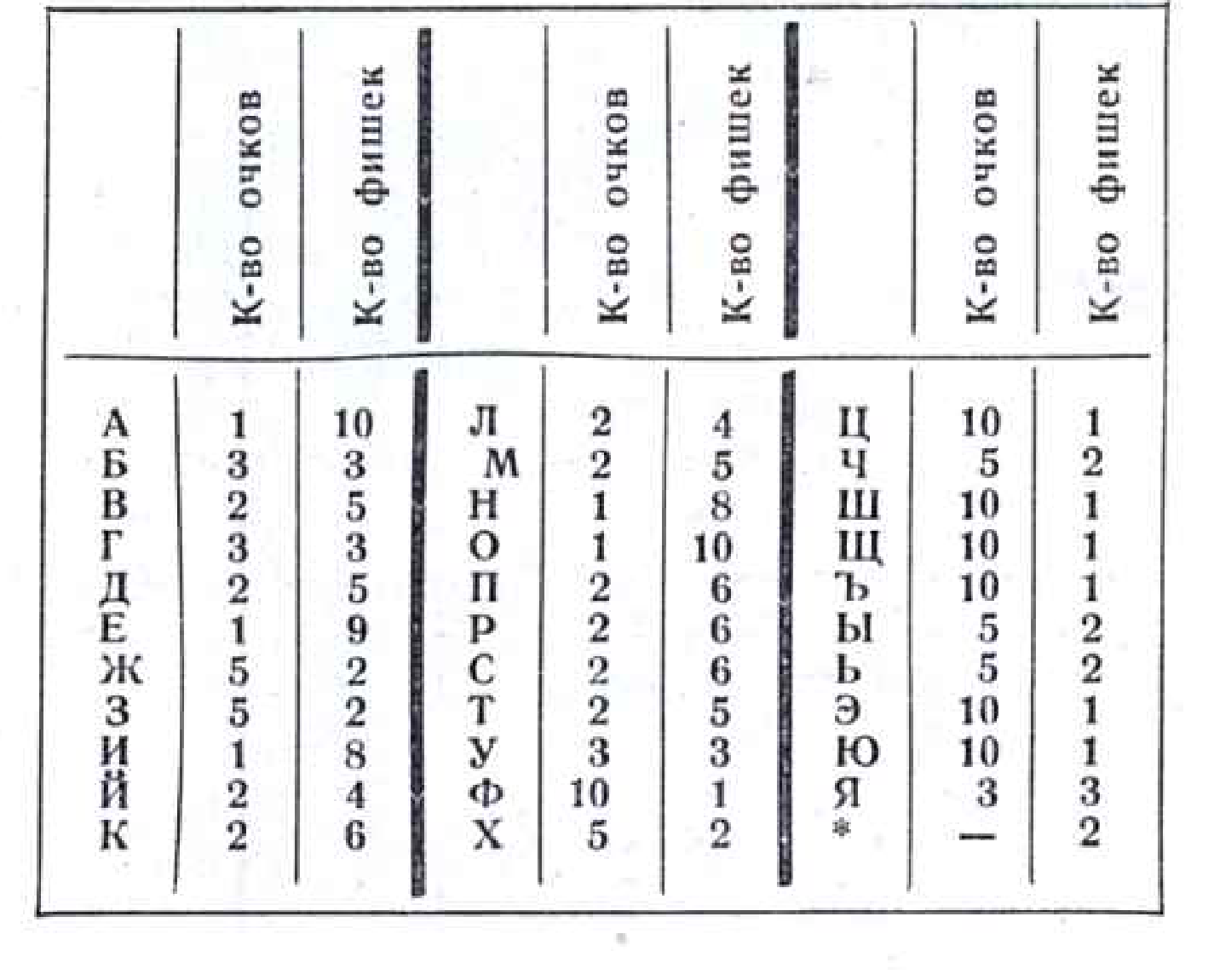
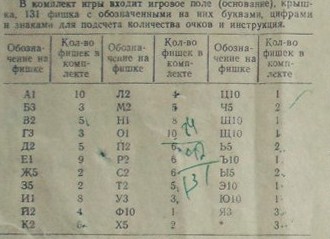
The table of points in our game is the same as in the classic Erudit («Erudite»): we built the game on it. The same table is printed in the magazine Nauka i Zhizn for 1968, in the article Krestoslovitsa («Crossword»). The set of letters is the same, 128 tiles. The special tiles that stand in for any letter differ: the magazine has two (blank), we have three (with an asterisk).
Here is what we noticed ourselves. The more common a letter is, the more such tiles there are in the set and the cheaper it is. We worked out exactly how the price relates to the number of tiles: divide 10 by the number of tiles. The letter «О» has 10 tiles and is worth 1 point. The letter «Ж» has 2 tiles and is worth 5 points. The letter «Ф» has one tile and is worth 10 points. It is the same for all 32 letters. If the division is not exact, we round: the letter «Й» has 4 tiles, 10 ÷ 4 = 2.5, so 2 points. The magazine does not state this rule; it says only that the price is inversely related to the frequency of the letter.
points = 10 ÷ number of tiles
- О1О: 10 tiles → 1 point
- Ж5Ж: 2 tiles → 5 points
- Ф10Ф: 1 tile → 10 points
The recount
We counted the letters in the dictionary Nominarium, the one players build words from: 60,301 words and 560,531 letters. Using a simple formula we turned the frequencies into tiles and points.
There is one important difference. The frequencies for the magazine were counted on business texts, that is, on words of all parts of speech. But in the game only nouns are played, so the frequency of letters among them may be different. The magazine says that corrections were made to its table to take nouns into account, but does not say which ones. Our recount relies only on nouns: on one of the most complete dictionaries of Russian nouns, Nominarium. It shows what the table would be like if we counted the way the game is played.
We got two tables: the 1968 table (Krestoslovitsa), which the game is built on today, and our recount using the Nominarium dictionary. Click any letter and compare the prices.
- ▲points went up
- ▼points went down
Only letters whose points changed have a frame.
Й
1968 table (Krestoslovitsa): 4 tiles, 2 points.
In the magazine the letter's frequency is 16 per 1,000 letters.
Our recount: 1 tile, 10 points.
The Nominarium dictionary has 560,531 letters, of which «Й» is 3,269 (0.58%). 128 × 0.58% = 0.7, that is 1 tile.
Letter «Й» occurs in the Nominarium dictionary almost three times less often than in the magazine.
Surprises
Letter «Й»
2 → 10 points
In the Nominarium dictionary of nouns it occurs almost three times less often than in the magazine's texts.
Letter «Я»
3 → 10 points
The letter «Я» also occurs less often, almost half as often.
Letters «Ф» and «Ш»
10 → 5 points
In the Nominarium dictionary they occur more often than in the magazine's texts.
Letters «Р» and «Т»
2 → 1 point
In Krestoslovitsa (1968) the letter «Т» has 5 tiles, even though it is a common letter: about 6 letters in 100. We recounted using the Nominarium dictionary and got 8 tiles for it. More tiles means each is cheaper: 1 point instead of 2. The same goes for the letter «Р». Why Krestoslovitsa has fewer tiles we do not know: the magazine Nauka i Zhizn mentions corrections but does not say which.
The test
We seated two computer players at the board and played 12,000 games: with the 1968 table (Krestoslovitsa) and with our recount. With our recount the games are 8–17% shorter and more points are scored per move. But the final score barely changed. Expensive letters did not start landing in the highest-scoring moves more often, and the letter «Ъ» is almost never played with either table.
Moves per game
- 1968 table
- Our recount
- Strong
- Medium
- Easy
Points per move
- 1968 table
- Our recount
- Strong
- Medium
- Easy
At the strong level the player who moves second wins more often: the starting player wins 12.9% of games with the 1968 table (Krestoslovitsa) and 5.2% with our recount. We have a guess why: the first move opens bonus squares for the opponent. We will check this later.
What we do not know
We tested the recount on computer players, not on people. Whether the game will be better for you, we do not know and do not claim.
The magazine says that corrections were made to its table, including ones that take into account where a letter stands in a word, but does not say which. We made no such corrections: all we have is a count of letters in the Nominarium dictionary.
Details
How the calculation works
- For each letter we count the number of occurrences n and the share n/N, where N is the number of all letters in the Nominarium dictionary («ё» is counted as «е»).
- Tiles: the integer part of 128 × n/N, at least one; the tiles missing up to 128 go to the letters with the largest remainder.
- Points: 10 ÷ number of tiles, rounded to a whole number; a value of 2.5 is rounded down.
With this formula, the tile counts of the 1968 table (Krestoslovitsa) give back its own points for all 32 letters.
Tables 1–4
Table 1. How many times each letter occurs
| Letter | Occurrences | Share, % | Per 1,000 letters |
|---|---|---|---|
| А | 53,493 | 9.543 | 95.4 |
| Б | 9,001 | 1.606 | 16.1 |
| В | 21,672 | 3.866 | 38.7 |
| Г | 8,454 | 1.508 | 15.1 |
| Д | 13,524 | 2.413 | 24.1 |
| Е | 48,299 | 8.617 | 86.2 |
| Ж | 3,733 | 0.666 | 6.7 |
| З | 9,380 | 1.673 | 16.7 |
| И | 48,176 | 8.595 | 85.9 |
| Й | 3,269 | 0.583 | 5.8 |
| К | 26,420 | 4.713 | 47.1 |
| Л | 23,724 | 4.232 | 42.3 |
| М | 13,563 | 2.42 | 24.2 |
| Н | 40,426 | 7.212 | 72.1 |
| О | 53,574 | 9.558 | 95.6 |
| П | 17,786 | 3.173 | 31.7 |
| Р | 34,783 | 6.205 | 62.1 |
| С | 28,558 | 5.095 | 50.9 |
| Т | 34,811 | 6.21 | 62.1 |
| У | 11,365 | 2.028 | 20.3 |
| Ф | 3,795 | 0.677 | 6.8 |
| Х | 3,507 | 0.626 | 6.3 |
| Ц | 6,357 | 1.134 | 11.3 |
| Ч | 6,290 | 1.122 | 11.2 |
| Ш | 4,166 | 0.743 | 7.4 |
| Щ | 3,015 | 0.538 | 5.4 |
| Ъ | 180 | 0.032 | 0.3 |
| Ы | 6,413 | 1.144 | 11.4 |
| Ь | 12,022 | 2.145 | 21.4 |
| Э | 1,516 | 0.27 | 2.7 |
| Ю | 1,484 | 0.265 | 2.6 |
| Я | 7,775 | 1.387 | 13.9 |
Table 2. Tiles and points: the 1968 table (Krestoslovitsa) and our recount
| Letter | 1968 table (tiles/points) | Our recount (tiles/points) |
|---|---|---|
| А | 10/1 | 12/1 |
| Б | 3/3 | 2/5 |
| В | 5/2 | 5/2 |
| Г | 3/3 | 2/5 |
| Д | 5/2 | 3/3 |
| Е | 9/1 | 11/1 |
| Ж | 2/5 | 1/10 |
| З | 2/5 | 2/5 |
| И | 8/1 | 11/1 |
| Й | 4/2 | 1/10 |
| К | 6/2 | 6/2 |
| Л | 4/2 | 5/2 |
| М | 5/2 | 3/3 |
| Н | 8/1 | 9/1 |
| О | 10/1 | 12/1 |
| П | 6/2 | 4/2 |
| Р | 6/2 | 8/1 |
| С | 6/2 | 6/2 |
| Т | 5/2 | 8/1 |
| У | 3/3 | 2/5 |
| Ф | 1/10 | 2/5 |
| Х | 2/5 | 1/10 |
| Ц | 1/10 | 1/10 |
| Ч | 2/5 | 1/10 |
| Ш | 1/10 | 2/5 |
| Щ | 1/10 | 1/10 |
| Ъ | 1/10 | 1/10 |
| Ы | 2/5 | 1/10 |
| Ь | 2/5 | 2/5 |
| Э | 1/10 | 1/10 |
| Ю | 1/10 | 1/10 |
| Я | 3/3 | 1/10 |
Table 3. Frequency per 1,000 letters: magazine and dictionary
| Letter | Magazine | Dictionary |
|---|---|---|
| А | 80 | 95.4 |
| Б | 17 | 16.1 |
| В | 57 | 38.7 |
| Г | 11 | 15.1 |
| Д | 39 | 24.1 |
| Е | 84 | 86.2 |
| Ж | 10 | 6.7 |
| З | 17 | 16.7 |
| И | 70 | 85.9 |
| Й | 16 | 5.8 |
| К | 26 | 47.1 |
| Л | 25 | 42.3 |
| М | 34 | 24.2 |
| Н | 72 | 72.1 |
| О | 105 | 95.6 |
| П | 37 | 31.7 |
| Р | 58 | 62.1 |
| С | 47 | 50.9 |
| Т | 62 | 62.1 |
| У | 20 | 20.3 |
| Ф | 2 | 6.8 |
| Х | 13 | 6.3 |
| Ц | 3 | 11.3 |
| Ч | 18 | 11.2 |
| Ш | 5 | 7.4 |
| Щ | 3 | 5.4 |
| Ъ | 0.3 | 0.3 |
| Ы | 18 | 11.4 |
| Ь | 17 | 21.4 |
| Э | 2 | 2.7 |
| Ю | 6 | 2.6 |
| Я | 25 | 13.9 |
Table 4. Computer-player games: the 1968 table (Krestoslovitsa) and our recount
Each cell: 1968 table (Krestoslovitsa) → our recount.
| Level | Moves per game | Points per move | Starting player won, % |
|---|---|---|---|
| Strong | 23.3 → 20.8 | 17.76 → 19.89 | 12.9 → 5.2 |
| Medium | 43.95 → 36.34 | 8.9 → 10.57 | 46.0 → 46.4 |
| Easy | 57.15 → 52.72 | 6.91 → 7.32 | 44.8 → 49.4 |
Frequencies: magazine and dictionary
Frequency per 1,000 letters
- Magazine
- Dictionary
- А
- Б
- В
- Г
- Д
- Е
- Ж
- З
- И
- Й
- К
- Л
- М
- Н
- О
- П
- Р
- С
- Т
- У
- Ф
- Х
- Ц
- Ч
- Ш
- Щ
- Ъ
- Ы
- Ь
- Э
- Ю
- Я
Sources
- Magazine Nauka i Zhizn, 1968, no. 7, pp. 150–152 (scan of the issue): https://publ.lib.ru/ARCHIVES/N/%27%27Nauka_i_jizn%27%27%27_(jurnal)/_NiJ_1960-69_.html
- Wikipedia. Alfred Mosher Butts: https://en.wikipedia.org/wiki/Alfred_Mosher_Butts
- Wikipedia. Scrabble letter distributions: https://en.wikipedia.org/wiki/Scrabble_letter_distributions
- P. Norvig. Letter Frequencies for Scrabble: https://norvig.com/scrabble-letter-scores.html
- tesera.ru, a supporting retelling: https://tesera.ru/article/iik14/