
History
Prehistory
In the early 1930s the American architect Alfred Butts lost his job because of the Great Depression and decided to invent a word game. The first version was called Lexiko: a set of 100 cardboard squares with letters, without a board. To work out how many of each letter were needed, he analyzed letter frequencies in newspapers and other printed texts: he counted letters in The New York Times, The New York Herald Tribune and The Saturday Evening Post. He gave the letters points from 1 to 10 according to frequency. In 1938 he took up a board game with a board based on Lexiko and called it Criss-Cross Words. In 1948 Butts teamed up with James Brunot: together they refined the rules and the design and gave the game its new name, Scrabble.
Slovomyot, 1962
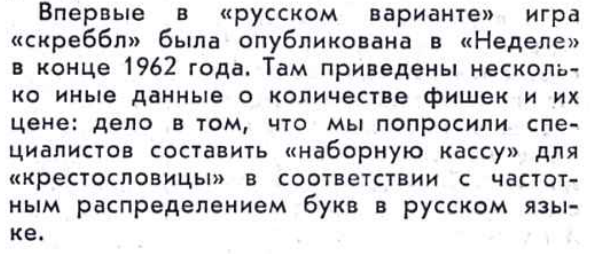
At the end of 1962 the game appeared in a Russian version: the magazine Nauka i Zhizn (Science and Life) reports that «scrabble» was first published in Nedelya («The Week»). In that publication, as the same magazine says, somewhat different figures for the number of tiles and their price were given. The magazine explains it this way: specialists were asked to compose a “type case” (the set of tiles) for Krestoslovitsa in line with the frequency distribution of letters in the Russian language.
Krestoslovitsa, 1968
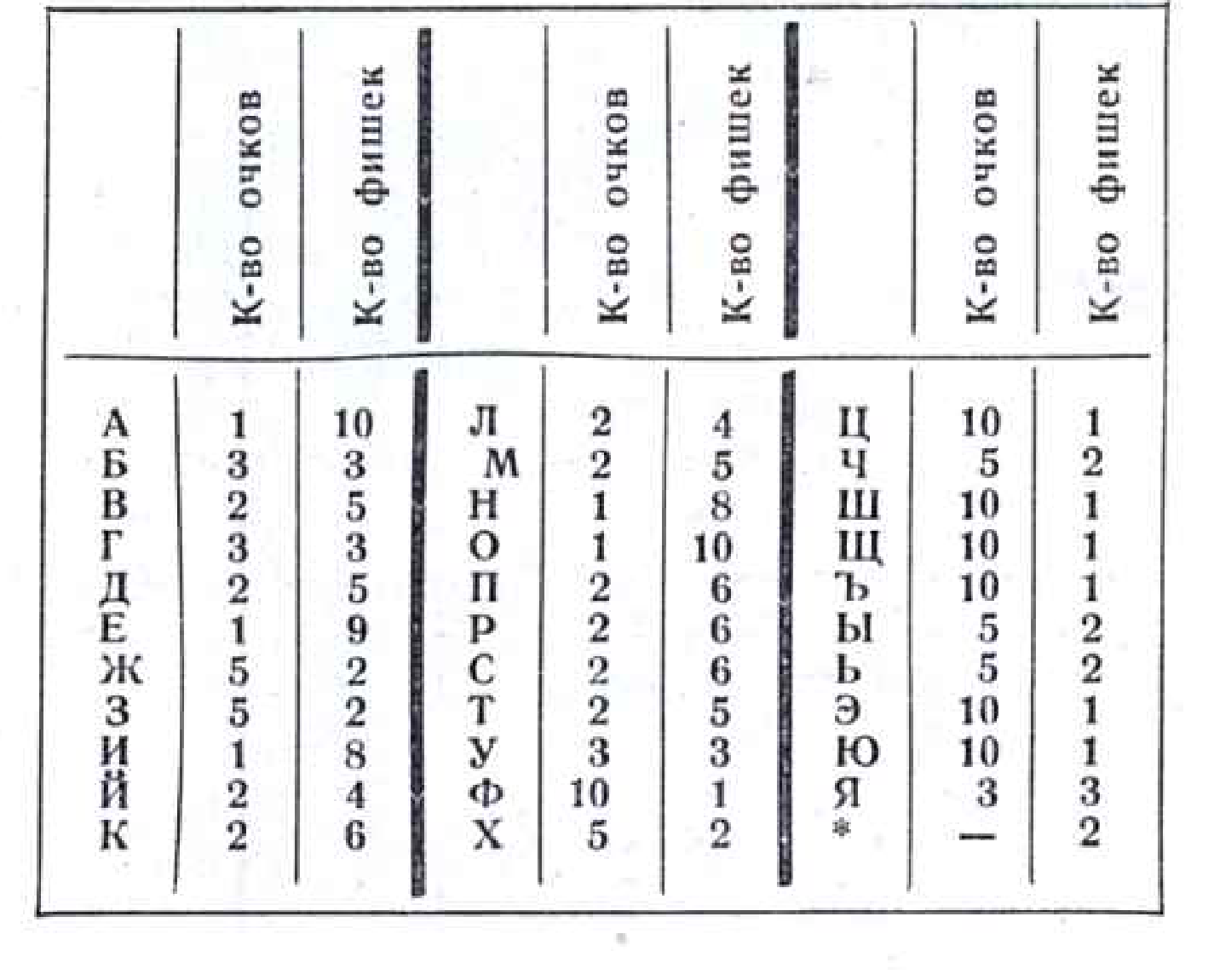
In issue no. 7 of Nauka i Zhizn for 1968, an article titled Krestoslovitsa («Crossword») was published with a table of points for the Russian alphabet. It was compiled by L. K. Graudina and V. A. Itskovich. The letter frequencies, based on business texts of about 200,000 letters, were counted by G. G. Belonogov and G. D. Frolov. Points are inversely proportional to frequency: the letter «А» is worth one point and there are ten such tiles, while the letter «Ж» is worth five points and there are two such tiles. The set has 130 tiles in all, two of them blank.
Slovograd
In Slovograd («Word City») we deliberately took the classic rules of the Soviet game Erudit («Erudite»), including the table of points. The same table is printed in Krestoslovitsa of 1968 (the magazine Nauka i Zhizn). The set of letters is the same, 128 tiles. The special tiles that stand in for any letter differ: the magazine has two (blank), we have three (with an asterisk). The game runs on the dictionary Nominarium and on a 15×15 board.